

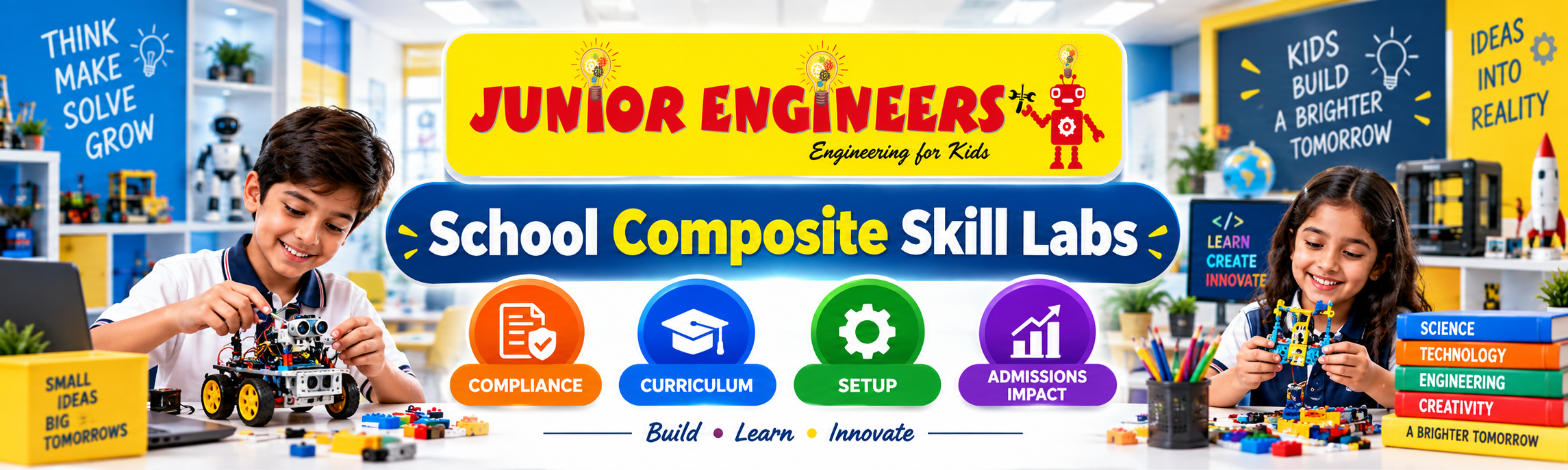
The Definitive Guide to School Composite Skill Labs: Compliance, Curriculum, Setup, and Admissions Impact
Running a school in the current educational landscape requires a complete departure from traditional operations. In the past, institutional success was measured almost entirely by textbook performance, standard classrooms, and examination pass percentages. Today, parents, school boards, and educational policymakers evaluate schools through an entirely different lens: practical readiness.
Parents want tangible proof that a school is preparing children for a technology-driven future. At the same time, central and state education boards are enforcing strict mandates requiring schools to transition away from rote memorization. Central to this transformation is the Composite Skill Lab (CSL).
For school owners, directors, principals, and trustees, understanding what a composite skill lab is, why boards have made it compulsory, and how to implement it on campus is no longer optional it is a critical requirement for institutional survival and growth.
1. What Exactly is a Composite Skill Lab?
For decades, school infrastructure was segregated. Schools maintained isolated rooms a computer lab in one corner, a physics laboratory down the hall, and little to no dedicated space for vocational or hands-on applied learning. A Composite Skill Lab shatters these outdated silos by bringing multi-disciplinary, future-focused skill development under a single, unified roof.
According to the structured frameworks outlined by national educational boards and curriculum guidelines, a fully functional composite skill lab is divided into three core domains of work:
A. Work with Life Forms
This domain connects students directly with nature, biology, and environmental ecosystems. Instead of just reading about plant biology in a textbook, students engage in practical biological and ecological activities:
- Setting up and maintaining organic plant nurseries and school gardens.
- Practicing modern hydroponics (growing plants in nutrient-rich water solutions without soil) and vertical farming modules.
- Monitoring local ecological factors, composting systems, and sustainability projects.
- Objective: Instilling practical responsibility toward biological systems, environmental science, and sustainable living practices.
B. Work with Materials and Machines
This is the physical engineering and hardware heart of the lab, designed to develop motor skills, spatial reasoning, and mechanical literacy. Students work with raw and semi-finished materials to build functional items:
- Assembling robotics kits, mechatronics models, and automated mechanical structures.
- Wiring basic electrical circuits, soldering components, and testing hardware using breadboards and microcontrollers.
- Utilizing basic woodworking tools, metal shaping instruments, and physical prototyping equipment.
- Objective: Developing fine motor skills, structural understanding, and hands-on troubleshooting capabilities.
C. Work in Human Services and Digital Skills
The modern economy runs on computing, digital systems, and service-oriented problem solving. This segment bridges the gap between traditional academics and the modern workforce:
- Computer programming stations running block-based coding environments, Python, and digital logic modules.
- Artificial Intelligence (AI) and Machine Learning (ML) foundational setups suitable for K-12 learners.
- Financial literacy modules, teaching young students basic banking concepts, budgeting, and entrepreneurial thinking.
- Objective: Preparing students for the digital economy, computational thinking, and modern financial management.
2. Why Has the Government Made Composite Skill Labs Compulsory?
The rapid push by regulatory bodies and boards like the CBSE to mandate skill labs is driven by structural changes in national education policies:
- Eliminating the Rote Learning Culture: Traditional schooling in India has long prioritized memorization over application. Education boards are introducing strict structural mandates to force schools to adopt experiential, inquiry-based learning models where students learn by doing.
- NEP 2020 and NCF Mandates: The National Education Policy explicitly dictates that vocational and technical skill exposure must begin early in school life. Schools are now required by policy to allocate dedicated weekly hours to practical skill development, which is impossible without dedicated physical infrastructure.
- Affiliation and Accreditation Compliance: Educational boards have made composite skill labs a non-negotiable prerequisite for new school affiliations. Existing schools are facing strict compliance deadlines to upgrade their campuses. Failing to meet these infrastructure guidelines risks board penalties, disaffiliation warnings, or loss of institutional accreditation.
3. How a Composite Skill Lab Drives School Growth and Admissions
Beyond regulatory compliance, installing a state-of-the-art skill lab transforms a school’s market position, financial viability, and academic reputation:
- The Ultimate Admission Magnet: During admission season, infrastructure is the primary evaluation metric for visiting parents. When a parent walks through your campus and sees an active robotics lab, 3D printing stations, and coding desks, their confidence in your institution multiplies instantly. It provides an undeniable Unique Selling Proposition (USP) that sets your school apart from local competitors.
- Massive Improvement in Concept Retention: Abstract mathematical and scientific theories often escape student memory when taught strictly on a blackboard. However, when a student physically codes a robotic arm to move or builds a functioning circuit, the underlying concept becomes permanent knowledge.
- Winning Competitions and Building Brand Prestige: A well-equipped lab gives your students the tools they need to participate and win in district, state, and national science exhibitions, robotics leagues, and coding hackathons. Every trophy won elevates the prestige of your school across your entire region.
4. Space, Infrastructure, and Layout Specifications
School leaders often hesitate to build labs out of concern that it requires massive architectural changes. In reality, board guidelines offer flexible sizing options to fit existing campus layouts:
- Single-Room Layout: A continuous, well-ventilated hall or room measuring a minimum of 600 square feet, engineered to house all three skill categories in well-defined zones.
- Two-Room Split Layout: If a single large hall is unavailable, schools can utilize two separate rooms of at least 400 square feet each designating one room for junior science and life forms, and the second room for senior robotics, computers, and mechanical workstations.
Essential On-Site Requirements:
- Electrical Load: Adequate wall-mounted 15A and 5A multi-plug lines to safely power computing devices, soldering stations, and electronic equipment without tripping circuits.
- Lighting and Ventilation: Bright, shadow-free overhead lighting combined with focused task lighting over workbenches, supplemented by proper room ventilation.
- Sturdy Furniture: Heavy-duty, chemical-resistant student workbenches with rounded edges, paired with wall-mounted tool pegboards to keep equipment organized and accessible.
- Safety Protocols: Clearly marked safety zones housing certified ABC-type fire extinguishers, fully stocked medical first-aid kits, and mandatory student safety gear.
5. Step-by-Step Blueprint: How to Build Your School’s Skill Lab
Executing a campus infrastructure upgrade without administrative friction requires a structured, phase-by-phase approach:
- Conduct a Campus Space Audit: Identify an accessible, well-lit room or hall that meets the minimum square footage requirements.
- Select an End-to-End Implementation Partner: Sourcing furniture from one vendor, electronic kits from a second, software from a third, and curriculum from a fourth creates endless administrative headaches. Partnering with a specialized turnkey provider streamlines the entire process.
- Collaborate with Junior Engineers: To eliminate operational friction, Junior Engineers manages the entire lifecycle of your lab setup. Our team visits your campus, drafts customized 2D and 3D space layouts, installs child-safe modular furniture and high-grade technical kits, and integrates the complete grade-wise curriculum. Most importantly, we provide hands-on training for your existing teachers so they can manage the lab with absolute confidence.
- Integrate into the Master Timetable: Once construction and installation are complete, map dedicated practical periods directly into the weekly school timetable to ensure every student utilizes the lab consistently.
Future-Proof Your School Today
Meeting board compliance, elevating parent trust, and giving your students the competitive edge they deserve doesn’t have to be complicated.
If you are ready to bring a world-class Composite Skill Lab to your campus, connect with our infrastructure experts at Junior Engineers. We will assess your space, respect your budget, and deliver a complete turnkey solution tailored precisely to your institution.
About Me

Junior Engineers (Engineering for kids) is an organisation specialising in Robotics education, aiming to provide the latest in Robotics education. Our objective is to introduce Junior Engineers programs to students in Schools, education centres and institutes in a fun, practical and scientific way.
Popular Post


Leave a Comment