

Financial Literacy Books for Schools in India: A Complete Money Skills Program for Grades 3 to 8
Schools prepare children for examinations, higher education and careers.
But there is another area of learning that has a direct impact on almost every student’s future.
Money.
Children will eventually earn money, spend it, save it, use banks, make digital payments, pay taxes and make financial decisions.
Yet many students reach adulthood without having learned these basics in a structured way.
Financial literacy gives schools an opportunity to change that.
It does not require turning children into finance specialists.
It simply means teaching them how money works and how to make sensible decisions with it.
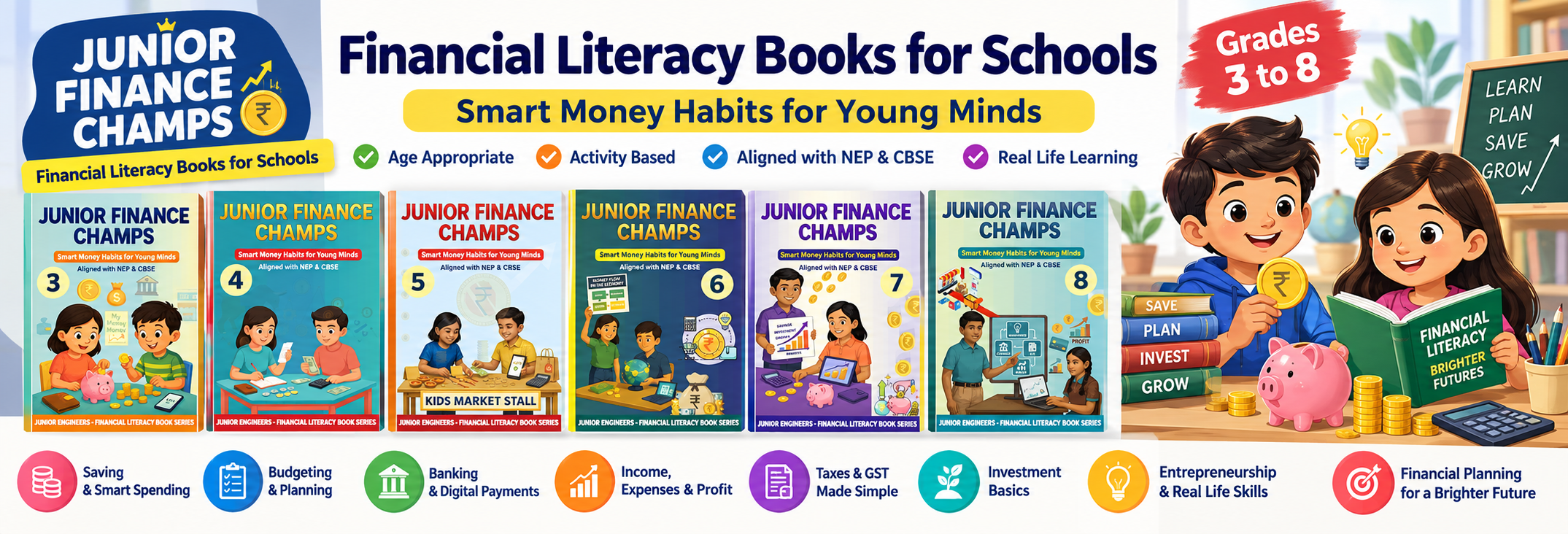
That is the purpose behind Junior Finance Champs, a structured financial literacy book series designed for students from Grades 3 to 8.
The program can be introduced by schools quickly because the learning is already organized grade by grade, with concepts, activities and practical examples suited to children.
Why Financial Literacy Matters for School Students
Children begin observing money long before they begin earning it. They see parents making payments at shops. They watch online orders being placed. They hear conversations about salaries, savings, discounts, bank accounts, EMI, GST and investments. They may receive pocket money.
They may save for a toy. They may compare the price of two products. They may ask why one item costs more than another.
In other words, children are already surrounded by financial decisions. What they often lack is a structured explanation of how those decisions work. Financial literacy gives them that foundation.
It helps children understand that money is not simply something we spend. It is something we earn, plan, save, manage and use responsibly.
Financial Literacy Is a Life Skill, Not Just a Finance Topic
Financial education is sometimes treated as something only commerce students need.
That is a very narrow way to look at it.
A future doctor will need to manage money.
An engineer will need to understand savings and taxation.
A designer may become self employed.
A teacher will need to plan expenses.
A professional may take a loan.
An entrepreneur will need to understand revenue, costs, profit and cash flow.
Whatever path a student chooses, money will be part of adult life.
That makes financial literacy relevant to every student.
Why Schools Should Introduce Financial Literacy Early
Children do not need complicated financial theories at a young age.
They need the right ideas at the right time.
A Grade 3 student can understand why saving ₹20 every week can help achieve a small goal.
A Grade 5 student can understand what a bank account does.
A Grade 6 student can understand income and expenses.
A Grade 7 student can begin thinking about investments and long term goals.
A Grade 8 student can understand the basic purpose of taxes, GST and entrepreneurship.
When concepts are introduced gradually, children have time to understand and practise them.
That is far more effective than waiting until adulthood and expecting young people to suddenly understand money on their own.
Junior Finance Champs: A Grade Wise Financial Literacy Program
One of the biggest challenges schools face while introducing a new subject is deciding what should be taught at each level.
Junior Finance Champs solves this through a progressive structure from Grades 3 to 8.
The learning becomes more practical and detailed as students grow older.
Grade 3: Understanding Money and Building Good Habits
At this stage, financial education should feel simple and familiar.
Children first explore what money is and why we use it. They learn to identify the role of money in everyday life through situations they already understand, such as buying stationery, receiving pocket money or saving for something they want.
Students are gradually introduced to the difference between a need and a want.
Food may be a need.
A second expensive toy may be a want.
The objective is not to tell children that wanting something is wrong. It is to help them understand that choices have priorities.
Saving is also introduced at this level.
Students begin to see saving as a positive habit rather than money that cannot be spent.
They can set small goals and understand that patience can help them achieve something they value.
Grade 4: Making Better Spending Decisions
Once students understand basic money concepts, they can begin learning how to make choices.
At this level, children can explore simple budgeting and smart shopping.
They can compare prices.
They can decide how to divide a fixed amount of money.
They can think about how much to spend and how much to save.
For example, a student may be given ₹500 and asked to plan spending for a book, a snack and savings.
The activity is simple, but the thinking behind it is important.
The student begins to understand that money is limited and every choice affects what remains.
This is the beginning of budgeting.
Grade 5: Understanding Banking and Digital Money
By Grade 5, many children have already seen ATMs, debit cards, UPI payments and online banking being used at home.
This is a good stage to explain what those systems actually do.
Students can learn why people use banks, what a savings account is, how deposits and withdrawals work and why money kept in a bank is different from cash kept at home.
They can also be introduced to digital payments.
A child who sees a parent scan a QR code should understand that the transaction still involves real money.
This is also the right time to introduce basic financial safety.
Children can learn why passwords, PINs and OTPs should never be shared.
They can understand why unknown payment links can be risky.
Financial literacy at this stage can support digital responsibility as well as money management.
Grade 6: Income, Expenses and the Basics of Business
Students can now begin exploring where money comes from.
Income is explained through familiar examples such as salaries, professional work, business income and services.
Students also learn about expenses.
They begin to understand that individuals and families have different types of expenses and that good planning means balancing income with spending.
This leads naturally into profit and loss.
Imagine a student makes handmade bookmarks for ₹20 each and sells them for ₹30.
What happened?
The student earned more than the cost.
That difference can be introduced as profit.
If the selling price is lower than the cost, the student experiences a loss.
Simple examples make business concepts much easier to understand.
Grade 7: Saving, Investment and Financial Goals
At this age, students can move beyond short term saving and begin thinking about longer term financial planning.
They can learn that saving and investing are not exactly the same.
Saving usually involves keeping money aside for future use.
Investment involves putting money into something with the expectation that it may grow over time.
Students should also understand an important point.
Growth is not guaranteed.
Investment can involve risk.
The purpose at this stage is not to tell children where to invest.
It is to help them understand how saving, investment, risk and time are connected.
They can also begin setting financial goals and thinking about how regular saving contributes to those goals.
Grade 8: Taxes, GST, Entrepreneurship and Financial Planning
By Grade 8, students can begin working with more practical financial concepts.
Taxes can be introduced by explaining why governments collect money and how public services are funded.
GST can be explained through a real or sample shopping bill.
Students can identify the basic price, the tax component and the final amount paid.
This makes a concept that sounds complicated much easier to understand.
Entrepreneurship can also become more detailed at this stage.
Students can create a simple business idea and think about product cost, selling price, customers, marketing, revenue and profit.
This brings together many concepts learned in earlier grades.
Students move from simply understanding money to thinking about how financial decisions work in the real world.
What Students Learn Through Junior Finance Champs
Junior Finance Champs is not built around isolated financial definitions.
Each area of learning connects with real situations students are likely to see at home, in shops, online and later in adult life.
Understanding Money and Its Value
Students begin by understanding why money exists, how it is used and why it has value.
They learn that money represents purchasing power and that every purchase involves a choice.
This helps children look at spending more thoughtfully.
Building a Saving Habit
Students learn that saving is about planning for the future.
They can set simple financial goals and understand how regular saving, even in small amounts, can help them reach those goals.
Over time, saving becomes a habit rather than an instruction.
Needs and Wants
Children learn to distinguish essential expenses from optional purchases.
This does not mean children should never buy something they want.
It teaches them to pause and ask whether a purchase is necessary, useful or simply desirable.
That ability becomes increasingly important as children grow older.
Budgeting
Budgeting teaches students that money has limits.
They learn how to divide a fixed amount between different priorities.
Through exercises involving food, transport, entertainment, savings and unexpected expenses, students begin to understand how planning helps avoid overspending.
Banking
Students understand why banks exist and how common banking services work.
They learn the purpose of savings accounts, deposits, withdrawals, debit cards and other basic services in language appropriate to their age.
Digital Payments and Financial Safety
Students explore how digital transactions work and why financial safety matters.
They learn that passwords, PINs and OTPs are private.
They also learn to check payments carefully and understand that convenience should never replace caution.
Income
Children learn that money is earned by providing work, skills, products or services.
This helps build respect for earning and connects financial education with future careers and entrepreneurship.
Expenses
Students learn how money is spent and why tracking expenses matters.
They can explore the difference between planned and unexpected expenses and understand how spending affects a budget.
Profit and Loss
Through small business examples, students understand how cost and selling price influence profit and loss.
This gives them an early foundation in business thinking.
Taxes
Older students learn why taxes are collected and how they contribute to public services.
The subject is introduced as part of everyday financial life rather than as a complicated legal topic.
GST
Students can examine sample invoices and understand how GST affects the final amount paid for goods and services.
This gives practical meaning to percentages and taxation.
Investment Basics
Students learn the difference between saving and investing.
They are introduced to concepts such as growth, time and risk without being encouraged towards any particular financial product.
The aim is understanding, not financial advice.
Entrepreneurship
Students learn how an idea can be turned into a simple business concept.
They can explore pricing, customers, costs, sales and profit while developing creativity and problem solving skills.
Financial Planning
Students learn how money decisions connect with future goals.
They understand that financial planning involves setting priorities, saving regularly, managing expenses and preparing for future needs.
Financial Literacy Should Be Practical
A financial literacy class should not feel like students are learning definitions for an examination.
It should feel connected to life.
A student should be able to look at a restaurant bill and understand what they are seeing.
They should be able to create a simple monthly budget.
They should understand why a ₹500 discount does not automatically make something a good purchase.
They should understand why a digital payment needs the same care as physical cash.
They should be able to plan how they might save towards a goal.
This is where activity based learning becomes important.
A classroom market, a mock bank activity, a savings challenge, a business project or a simple family budget exercise can teach financial concepts far more effectively than memorisation alone.
Financial Literacy Makes Mathematics More Meaningful
One of the strongest advantages of financial education is that it gives mathematical concepts a real purpose.
Percentages become easier to understand when students calculate discounts or GST.
Addition and subtraction become practical when they create budgets.
Multiplication can be used to calculate monthly or annual savings.
Profit and loss give arithmetic a business context.
Financial literacy can therefore support classroom mathematics while also teaching practical life skills.
It Also Develops Better Decision Making
Money education is ultimately about decisions.
Should I spend now or save?
Can I afford this?
Do I need it?
Should I compare prices?
What happens if an unexpected expense appears?
What does this purchase mean for the rest of my budget?
These questions develop judgement.
Children begin to understand that financial decisions have consequences.
That ability is useful far beyond money.
Why Junior Finance Champs Is Easy for Schools to Introduce
A good school program should not create unnecessary pressure for teachers or administrators.
This is where a structured book series becomes valuable.
Schools do not need to spend months deciding what financial topics should be taught in every grade.
They do not need to build an entire curriculum from the beginning.
They do not need to turn financial literacy into a difficult new academic subject.
Junior Finance Champs provides a grade wise pathway from Grades 3 to 8.
Schools can introduce the books through their existing academic or enrichment structure.
Possible formats include life skills periods, activity periods, skill education sessions, mathematics enrichment, clubs or a dedicated weekly financial literacy class.
The school can choose the model that best fits its timetable.
A Practical School Implementation Model
Schools can begin with a simple approach.
Start with the grades where the program is required.
Assign a regular period weekly or according to the school calendar.
Use the books as the core classroom resource.
Encourage teachers to combine reading with practical discussion and activities.
Allow students to take some activities home and discuss them with parents.
Conclude units with small projects such as budgeting exercises, market activities or entrepreneurship tasks.
The important point is consistency.
Financial literacy does not require a complicated launch.
A clear book, a trained teacher and regular classroom time can create a strong beginning.
Teachers Should Not Need a Finance Degree
Financial literacy material for schools should be easy to teach.
A classroom teacher should be able to understand the concept, explain it in simple language and conduct the accompanying activity.
That is why school resources need clear explanations, relatable examples and well planned activities.
The objective is not to make financial education dependent on specialist finance teachers.
The objective is to make practical money education accessible across the school.
Indian Students Need Indian Examples
A child learns faster when the example feels familiar.
For Indian students, financial literacy should connect with the world they actually see.
Rupees.
UPI.
GST.
Indian banking systems.
Pocket money.
Local shops.
School canteens.
Household spending.
Small businesses.
Realistic Indian situations make financial concepts easier to understand and discuss.
Financial Literacy Can Become a Strong School Initiative
Parents increasingly appreciate schools that teach practical skills alongside academics.
A financial literacy program gives schools something meaningful to offer.
It tells parents that the school is thinking beyond examinations.
It shows that students are being prepared for everyday decisions.
It creates opportunities for exhibitions, student markets, entrepreneurship days, financial awareness activities and interdisciplinary projects.
A well implemented program can become a visible part of the school’s life skills education.
Junior Finance Champs for Grades 3 to 8
Junior Finance Champs is designed to give schools a structured pathway for financial education.
The series takes students from basic money understanding to practical concepts such as budgeting, banking, digital payments, income, expenses, profit and loss, taxation, investment awareness, entrepreneurship and financial planning.
Most importantly, each stage is designed around the child’s level of understanding.
The objective is not to teach children everything about finance.
It is to give them the foundation they need to make better decisions as they grow.
Frequently Asked Questions
What are financial literacy books for schools?
Financial literacy books for schools are structured learning resources that teach children practical money concepts such as saving, budgeting, banking, digital payments, income, expenses, taxes, GST, investment awareness and entrepreneurship.
What grades are Junior Finance Champs designed for?
Junior Finance Champs is designed as a progressive financial literacy book series for students from Grades 3 to 8.
Why should financial literacy start in primary school?
Primary school students are already exposed to money, spending and saving. Introducing simple concepts early helps children build healthy habits before financial decisions become more complicated.
Does financial literacy require a separate subject?
Not necessarily. Schools can introduce the books through life skills, activity periods, mathematics enrichment, skill education, clubs or a dedicated financial literacy period.
Do schools need specialist finance teachers?
A well designed school financial literacy program should be simple enough for regular teachers to facilitate with suitable books, examples and classroom activities.
What makes financial literacy useful for students?
Financial literacy connects classroom learning with everyday life. Students learn how to save, plan, budget, understand banking, make digital payments safely, read bills and make more thoughtful financial decisions.
Can financial literacy support entrepreneurship education?
Yes. Students can use financial concepts to understand product cost, selling price, revenue, profit, customers and basic business planning.
Is financial literacy useful even for students who will not study commerce?
Yes. Every adult needs to manage money regardless of their profession. Financial literacy is a practical life skill, not only a commerce subject.
The Real Purpose of Financial Education
The purpose of financial literacy is not to make a Grade 5 child think like an accountant.
It is not to make children worry about money.
And it is certainly not to turn the classroom into a finance lecture.
The purpose is much simpler.
A child should understand that money has value.
A child should learn that saving requires patience.
A child should know that spending involves choices.
A child should understand that digital payments require responsibility.
An older student should understand what a budget is, why taxes exist, how profit works and why investments involve risk.
These small lessons become useful habits.
And those habits can remain long after the textbook has been completed.
Final Thought for Schools
Schools prepare children for a future that cannot be predicted in every detail.
Careers will change.
Technology will change.
The way people pay and manage money will continue to change.
But the need to make sensible financial decisions will remain.
That is why financial literacy deserves to be taught early and taught well.
With Junior Finance Champs, schools can introduce a structured financial literacy program from Grades 3 to 8 without turning it into another complicated academic burden.
The books provide the learning path.
The concepts grow with the child.
The examples connect with real life.
The activities encourage children to think.
And the learning prepares students for something every one of them will eventually need.
Managing money responsibly.
Junior Finance Champs
Financial Literacy Books for Schools
Grades 3 to 8
Smart Money Habits for Young Minds
You May Also Like

Junior Finance Champs: A Fin ...
27 May 2026

Robotics Classes, Coding Cla ...
24 December 2025
Financial Literacy Program f ...
22 December 2025
About Me

Junior Engineers (Engineering for kids) is an organisation specialising in Robotics education, aiming to provide the latest in Robotics education. Our objective is to introduce Junior Engineers programs to students in Schools, education centres and institutes in a fun, practical and scientific way.


Leave a Comment