
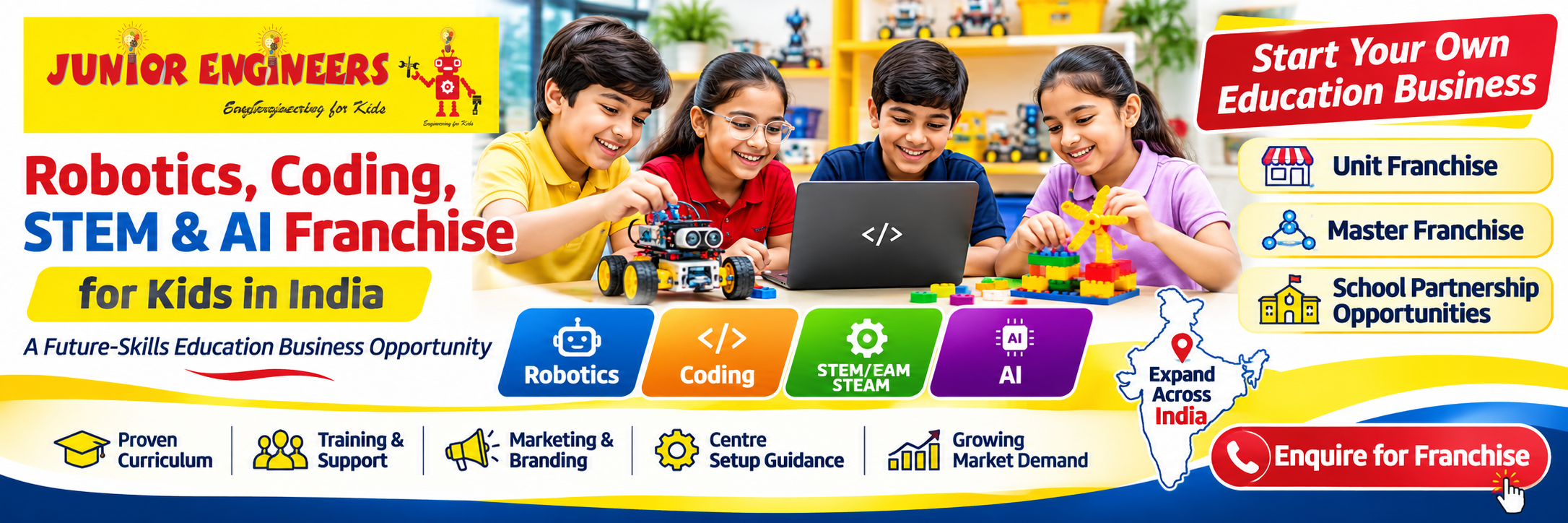
Build a Future-Skills Education Business with Junior Engineers – Engineering for Kids
Robotics Franchise | Coding Franchise | STEM Education Franchise | AI Education Programs | School Partnerships | Unit Franchise | Master Franchise
Are you planning to start your own education business in India? Are you looking for a Robotics and Coding Franchise, a STEM Education Franchise, or an opportunity to introduce Artificial Intelligence (AI) education for children?
Perhaps you are an entrepreneur looking to invest in the education sector, a teacher interested in starting your own academy, an engineer exploring a new business venture, or an existing coaching centre owner who wants to expand into technology education.
You may also be an investor seeking a larger opportunity through a Master Franchise in Robotics, Coding, STEM and AI Education, with the potential to develop a network of learning centres and school partnerships.
Whatever your background, the important question is not simply whether robotics and coding are popular subjects.
The real question is:
Can you build a well-managed education business that delivers meaningful learning experiences to children while developing a sustainable commercial model?
That is the opportunity worth exploring with Junior Engineers – Engineering for Kids.
Junior Engineers offers practical technology education programs for children, including Robotics, Coding, Mechanical Engineering, Electronics, STEM and STEAM activities, as well as additional technology-focused learning resources.
Through its franchise model, Junior Engineers provides entrepreneurs with an opportunity to explore establishing branded education centres and developing school-related educational services under agreed commercial terms.
For the right franchise partner, the business can be more than a classroom offering one subject. It can be a locally recognised future-skills education centre where children learn to build machines, create games, understand technology and develop practical problem-solving skills.
In this complete guide, we explain the different franchise opportunities, educational programs, school partnership possibilities, business development strategies, and key considerations for anyone interested in a Robotics, Coding, STEM and AI Franchise for Kids in India.
1. Why Robotics, Coding, STEM and AI Education Is an Opportunity Worth Exploring
Education has never been limited to memorising facts or preparing for examinations.
Children also need opportunities to explore, experiment, collaborate, communicate and apply what they learn.
Technology education offers several practical ways to support this process.
A child building a robotic vehicle can explore gears, wheels, motors and mechanical movement.
A student creating a Scratch game can practise sequencing, conditions, variables and problem-solving.
A group designing a bridge can investigate structure, stability and engineering principles.
An older learner exploring artificial intelligence can begin understanding how data, patterns and algorithms influence digital systems.
These activities can make subjects such as science, mathematics and computing more tangible.
For entrepreneurs, the commercial opportunity lies in making such learning experiences accessible through structured, professionally managed educational programs.
Why Is 2026-2027 Relevant for Technology Education?
India’s National Education Policy 2020 emphasises contemporary subjects, computational thinking, experiential learning and skills development.
A significant development occurred on April 1, 2026, when CBSE introduced its Computational Thinking and Artificial Intelligence curriculum framework for Classes III–VIII for the 2026-27 academic session.
This development reflects the importance being placed on computational thinking, logical reasoning, digital literacy and the responsible understanding of artificial intelligence.
It also creates a useful context for education providers developing relevant learning experiences.
However, introducing a private robotics or AI franchise does not automatically make it CBSE-approved or officially affiliated with the board.
Schools must evaluate external providers independently and ensure that the educational programs they use are appropriate for their curriculum and students.
For prospective franchisees, this is an opportunity to research local demand for practical technology education and explore how a specialised academy could serve families and institutions.
2. What Is a Robotics, Coding, STEM and AI Franchise for Kids?
A Robotics, Coding, STEM and AI Education Franchise is a business arrangement in which an entrepreneur operates approved education programs under a recognised brand, following an agreed commercial and operational framework.
Instead of independently developing every lesson plan, teaching method, learning resource, brand identity and operating procedure, the franchise partner can work with resources and support systems supplied under the franchise agreement.
A future-skills education centre may deliver several types of learning activities.
Robotics: Students explore how machines, motors, sensors and programmable systems work.
Coding: Children create animations, games, interactive projects and programs.
STEM Education: Learners investigate science, technology, engineering and mathematics through practical challenges.
STEAM Education: Creative design and artistic thinking are integrated into STEM activities.
Artificial Intelligence: Age-appropriate activities introduce concepts such as pattern recognition, data, algorithms, AI applications and responsible technology use.
Electronics: Students explore circuits, switches, LEDs, motors and electronic components.
Mechanical Engineering: Children learn about structures, movement, gears, wheels, pulleys and simple machines.
Together, these subjects can support a broad educational offering for different age groups.
The exact programs a Junior Engineers franchise partner may deliver depend on the selected package, training arrangements and written agreement.
3. Junior Engineers – A Practical Learning Approach for Future Innovators
At Junior Engineers, the central educational idea is straightforward:
Children learn more about technology when they have opportunities to build, experiment, create and discover how things work.
Rather than relying only on theoretical explanations, the Junior Engineers learning approach encourages practical activities and structured progression.
Its published educational programs include several learning pathways.
iConstruct – Creative Construction and Engineering
Young learners explore construction, structures, mechanisms and design through practical building activities.
This introduces basic engineering concepts while encouraging creativity and experimentation.
iEngineer – Mechanical Engineering Concepts
Students investigate gears, wheels, axles, movement, levers, pulleys and machines.
Projects help children connect mechanical concepts with everyday objects and working models.
iElectric – Electricity and Electronics
Children explore introductory electrical and electronic concepts through suitable hands-on activities.
Topics may include circuits, switches, LEDs, motors and basic components.
iRobo – Robotics Education
Students develop an understanding of robotic mechanisms, motors, sensors, programming and automation through progressive learning activities.
Learning tasks become more advanced according to the student’s age and experience.
iCoder – Coding and Programming
Students can explore visual programming, Scratch, interactive games, app-development concepts, web-development fundamentals and Python.
The learning pathway begins with accessible activities and develops towards more detailed programming tasks.
3D Design and Printing
Where suitable equipment and educational resources are available, students may explore digital design, model creation and introductory 3D printing.
Techverse and Additional Learning Resources
Junior Engineers also lists Techverse and other educational resources as part of its wider offering.
These can create opportunities to discuss school technology education, curriculum materials and related learning programs.
Artificial Intelligence Learning Opportunities
AI education can be introduced through age-appropriate activities involving patterns, data, algorithms, decisions, real-life AI examples and responsible technology use.
For example, younger children may classify pictures or identify patterns, while older learners can investigate how data influences automated decisions.
AI instruction should be designed around educational understanding rather than promising advanced machine-learning expertise to very young children.
Prospective franchise partners should confirm which AI modules, robotics kits, books and curriculum resources are included in their particular agreement.
4. Unit Franchise vs Master Franchise – Which Business Model Should You Choose?
One of the most important decisions for a prospective investor is choosing the right franchise format.
Junior Engineers franchise enquiries may involve interest in an individual learning centre, broader territorial development, or school-focused educational services.
The commercial structure, rights and obligations of each arrangement should be established through a current written proposal.
Option 1: Junior Engineers Unit Franchise
Suitable for entrepreneurs who want to develop and operate an individual education centre.
A Unit Franchise may appeal to teachers, engineers, working professionals, education entrepreneurs, women entrepreneurs and existing activity centre owners.
Under an agreed unit model, the franchisee concentrates on developing a defined learning centre and serving students within the approved territory.
The owner may focus on activities such as:
- Regular robotics and coding classes
- Age-appropriate STEM and engineering programs
- Weekend learning batches
- School-holiday workshops
- Parent demonstrations and community activities
- Local admissions and student retention
The strength of this model lies in developing a trusted local learning centre.
A successful operator must focus on the quality of teaching, parental communication, appropriate staffing, student progress and financially responsible management.
A Unit Franchise is not automatically a passive investment. It is a business that requires regular supervision and active development.
Option 2: Junior Engineers Master Franchise
Suitable for investors and experienced business operators interested in a broader territorial development opportunity.
A Master Franchise arrangement may involve rights and responsibilities beyond those of a single-centre operator.
Depending on the negotiated agreement, a master partner may participate in developing a larger territory, supporting approved centres, expanding school relationships or facilitating business growth.
The exact scope could include regional brand development, partner support, operational oversight, school outreach or other agreed responsibilities.
However, territorial exclusivity, rights to appoint sub-franchisees, revenue-sharing arrangements and the ability to open additional centres must never be assumed.
All such rights must be explicitly recorded in the agreement.
Prospective master franchise investors should request clarity about performance milestones, territory boundaries, minimum development commitments, ongoing fees and support responsibilities.
Option 3: School-Focused Robotics, Coding and STEM Business
Suitable for educators and business partners who want to work with schools and educational institutions.
A school-focused model may involve delivering structured technology classes, practical STEM workshops, teacher training, or approved school laboratory services.
It requires a different approach from running a neighbourhood after-school centre.
School partnerships generally involve institutional proposals, academic requirements, management approvals, contractual obligations and scheduled service delivery.
School services and partnership rights must be specifically authorised within the applicable agreement.
Choosing Between These Models
If your priority is managing one centre and developing local student admissions, a Unit Franchise may be worth exploring.
If you have experience managing teams, expanding businesses and developing larger networks, a Master Franchise may be more relevant.
If your strength lies in institutional sales, education management or school relationships, a school-focused opportunity may deserve attention.
The right model depends on your experience, investment capacity, operational resources and business ambitions.
5. What Makes a Multi-Program Education Franchise Different?
A traditional tuition centre may focus on academic revision in a small number of subjects.
A technology learning centre can introduce several complementary educational programs.
This is valuable because children do not all have the same interests.
Some children love machines and construction.
Others prefer computer programming, storytelling, puzzles, or digital games.
Younger students may enjoy LEGO and building activities, while older learners may be interested in Python, electronics and automation.
A multi-program centre can serve these different interests through age-appropriate learning pathways.
A Possible Learning Journey
A young child might begin with simple STEM and construction activities.
As the child becomes older, they may explore mechanical engineering and beginner robotics.
Later, they might develop an interest in Scratch coding, robotics programming or electronics.
A teenager may then explore Python, more advanced projects, AI concepts or digital design.
Not every student will follow this sequence, but a progressive curriculum gives families opportunities to continue learning.
For a franchise operator, having several relevant educational programs may help develop broader customer relationships.
It does not automatically guarantee student retention or increased revenue; those outcomes depend on teaching quality, demand and operating performance.
6. Who Can Start a Robotics, Coding, STEM and AI Franchise?
A technology education franchise is not limited to software developers or robotics engineers.
Different professional backgrounds can bring useful strengths to an education business.
Women Entrepreneurs
Women interested in education, teaching, child development and entrepreneurship may explore operating a local learning centre.
A structured curriculum and appropriate technical training can help an owner build the necessary subject familiarity.
However, the business still requires sales, staffing, marketing and financial management.
Teachers and Education Professionals
Teachers already understand lesson planning, classroom management and student needs.
They may consider technology education as an opportunity to establish their own academy or expand their professional activities.
Engineers and IT Professionals
Engineers and technology professionals may be comfortable with technical subjects and project-based learning.
With suitable training in teaching methods and child development, they may be well placed to support technical education programs.
Existing Coaching and Activity Centre Owners
Owners of tuition centres, abacus academies, preschools, computer institutes and after-school centres may explore adding robotics and coding to their existing programs.
Depending on the model and agreement, an established facility may offer some infrastructure advantages.
School Owners and Education Groups
School management teams or education groups may be interested in dedicated technology learning centres, curriculum enrichment and practical learning services.
Business Investors
Investors who have experience managing businesses, teams, sales and operations may explore Unit or Master Franchise opportunities.
They should evaluate the amount of active involvement required rather than assuming that owning the franchise guarantees passive income.
7. More Than One Business Opportunity: Explore Different Educational Services
An attractive aspect of a future-skills education business is the possibility of developing services for different audiences.
A franchise partner’s permitted services depend on the agreement and their operational capabilities.
Regular After-School Classes
Children attend structured robotics, coding or engineering classes on a recurring schedule.
This model depends on student enrolment, quality teaching and consistent parent communication.
Weekend Technology Programs
Weekend batches may appeal to families who find weekday scheduling difficult.
A suitable schedule can help the centre serve students from nearby residential areas.
Summer Camps and Winter Camps
Holiday programs can introduce children to LEGO construction, robotics, coding and other STEM activities.
These may also help families discover whether they want to enrol in a longer course.
Camp revenue is seasonal, so it should not be treated as guaranteed year-round income.
Workshops and Community Events
Short workshops, coding challenges, engineering demonstrations and science activities can introduce families to the academy.
They may also create opportunities for local awareness and community engagement.
School Robotics and Coding Classes
School-approved technology programs can introduce practical activities within an institutional timetable.
These services require suitable curriculum planning, trainer availability and a formal agreement with the school.
Technology Learning Resources
Where permitted, a franchise partner may explore the distribution or sale of approved educational books, kits and other learning resources.
Commercial rights, supplier requirements and margins must be confirmed separately.
Competitions and Innovation Events
Robotics and coding exhibitions or competitions can give students opportunities to demonstrate their projects.
They can also help build community engagement, provided participation offers genuine educational value and events are professionally organised.
The objective should be to build a balanced education business rather than depending on a single promotional activity.
8. Robotics and AI Programs for Schools – An Institutional Opportunity
School partnerships deserve particular attention from entrepreneurs who are interested in combining education delivery with business development.
Schools may seek support for practical STEM learning, robotics activities, coding classes, technology workshops and teacher development.
However, every school has its own priorities, budget, curriculum requirements and approval processes.
How Can a Franchise Partner Approach Schools?
The first step is to understand the school’s educational needs.
A primary school may be interested in simple machines, creative construction, coding fundamentals and practical STEM activities.
A middle school may be exploring computational thinking, robotics, introductory electronics and AI awareness.
An institution developing a larger technology program may be interested in instructor training, activity plans or laboratory infrastructure.
A franchise partner should prepare a proposal that describes the educational objectives, eligible grades, teaching arrangements, required resources, service charges and responsibilities.
Possible School Services
Depending on the approved business arrangement, relevant services may include:
Robotics and Engineering Classes
Hands-on mechanical and robotics activities delivered according to a structured timetable.
Coding and Computational Thinking Programs
Age-appropriate digital projects, Scratch programming, introductory algorithms and other relevant activities.
STEM Learning Workshops
Practical projects connecting science, mathematics, design and engineering.
AI Awareness and Computational Thinking Activities
Lessons introducing patterns, data, algorithms, AI applications and responsible technology use.
Teacher Training
Suitable professional learning sessions for teachers introducing practical technology activities.
School Technology Lab Support
Where specifically authorised, services associated with school robotics or STEM laboratory implementation.
A Practical School Partnership Process
A professional school outreach process may follow these stages:
- Identify schools that may benefit from the proposed service.
- Understand the age groups, curriculum priorities and available facilities.
- Present relevant educational activities and learning outcomes.
- Arrange a demonstration or academic discussion where invited.
- Submit a written proposal covering deliverables, resources and pricing.
- Obtain school approvals and finalise contractual arrangements.
- Deliver the program through suitably prepared instructors.
- Provide agreed student progress updates and program reviews.
This approach puts educational value first and helps schools evaluate whether the proposed service is appropriate.
No particular number of school partnerships or institutional contracts can be guaranteed.
9. How Junior Engineers Supports Its Franchise Partners
Starting an independent technology academy requires decisions about curriculum, educational materials, equipment, teaching methods, branding and day-to-day operations.
Junior Engineers’ published franchise information identifies several support areas that prospective partners can explore.
Curriculum and Teaching Resources
Structured learning resources help centres organise activities according to course objectives and student progression.
Technical Training
Junior Engineers lists technical and teacher-training support as part of its franchise services.
Training arrangements should be confirmed for the selected programs and model.
Centre Setup Guidance
Support may include guidance on classroom planning, equipment needs and the development of an appropriate learning environment.
Branding and Marketing
The franchise model includes marketing and advertising support.
Prospective partners should discuss the specific materials, activities, responsibilities and campaign budgets involved.
Business Management Guidance
The published franchise model identifies business-management and day-to-day operational support as relevant areas.
Curriculum Development
Junior Engineers also identifies research, development and curriculum updates as part of its support approach.
Recruitment and Trainer Preparation
Technical training and recruitment support are included among the support categories described on the official franchise website.
The scope of support should always be documented in the current franchise proposal.
A prospective partner should understand exactly what is included, what carries an additional cost, and what remains the franchisee’s own responsibility.
10. How Much Investment Is Required for a Robotics, Coding, STEM and AI Franchise?
Investment is an important consideration, but the amount depends on the selected business model.
An individual academy, a larger technology centre, a school-focused service operation and a Master Franchise do not necessarily have the same financial requirements.
What Can Affect the Total Investment?
Key components may include:
- Initial franchise and training charges
- Learning kits and educational equipment
- Computers and digital infrastructure
- Premises deposits and rent
- Furniture and classroom interiors
- Staff recruitment and training
- Marketing and launch expenses
- Technology maintenance
- Working capital
- Applicable taxes and recurring contractual charges
The publicly listed Junior Engineers franchise information describes an indicative investment range for a specified franchise format, but a current quotation should be requested for the actual package being considered.
Unit Franchise and Master Franchise applicants should request separate written investment proposals.
A larger territory or broader set of business rights should not be assumed to have the same pricing as a single-centre arrangement.
It is also important to understand the difference between the franchise package price and the total funds required to launch and operate the business.
Is a Robotics Franchise Profitable?
A robotics and coding academy can potentially generate operating profits if its revenue exceeds the costs of delivering its programs.
However, profitability depends on student enrolment, fees, premises, staff expenses, equipment, marketing, retention, franchise charges and other factors.
School partnerships and workshops may create additional opportunities, but they also involve delivery costs and operational commitments.
There is no universal return on investment or guaranteed break-even timeline.
Before joining, prepare a business plan using realistic assumptions for your proposed location.
Request a current Junior Engineers franchise proposal to evaluate the investment requirements for your city and preferred business model.
11. How to Generate Student Admissions for a Robotics and Coding Academy
Opening a classroom is only the beginning.
A franchise partner must also explain the value of the programs to parents and build trust in the local community.
Demonstrate Real Projects
Show parents what children can build or create.
A working robot, Scratch game, mechanical model or coding project often communicates the learning experience more clearly than a long promotional description.
Focus on Local Searches
Parents commonly search for phrases such as:
Robotics Classes Near Me, Coding Classes for Kids Near Me, STEM Classes in My City, Weekend Robotics Classes, LEGO Classes for Kids and Python Classes for Children.
A franchisee can develop accurate local pages and maintain appropriate business information so families can discover the centre.
Build Relationships with Schools
Schools may be interested in educational demonstrations, workshops or structured proposals.
Approach institutions professionally, with clear learning objectives and realistic service commitments.
Organise Workshops
Introductory activities can help children explore the programs before selecting a longer course.
Communicate Student Progress
Parents should understand what their child is learning, which projects have been completed and what concepts will be introduced next.
Develop a Long-Term Learning Pathway
Students may progress through multiple levels or explore related subjects according to their interests.
A strong education business should prioritise genuine learning and consistent service rather than high-pressure selling.
12. Robotics and Coding Franchise Opportunities Across India
Entrepreneurs in both metropolitan and developing cities may be interested in introducing practical technology education.
However, every proposed location requires a separate feasibility assessment.
An entrepreneur in Delhi NCR may have different rent, staffing and customer expectations from an entrepreneur in Surat, Jaipur or Lucknow.
Before selecting a territory, investigate local school networks, competing learning programs, household budgets, transport access and potential student demand.
Cities Where Entrepreneurs Can Enquire
Delhi NCR: Delhi, Ghaziabad, Noida, Greater Noida, Gurugram and Faridabad.
Maharashtra: Mumbai, Pune, Nagpur, Nashik and Thane.
Karnataka: Bengaluru, Mysuru and Mangaluru.
Telangana: Hyderabad and nearby urban areas.
Gujarat: Ahmedabad, Surat, Vadodara and Rajkot.
Rajasthan: Jaipur, Jodhpur, Udaipur and Kota.
Uttar Pradesh: Lucknow, Kanpur, Agra, Meerut and Varanasi.
Other Cities: Chandigarh, Mohali, Panchkula, Indore, Bhopal, Kolkata, Chennai, Dehradun, Patna, Kochi, Coimbatore and Bhubaneswar.
These locations are suggestions for franchise enquiries and market research, not confirmation that every territory is available.
For regional investors, Junior Engineers can be contacted to discuss whether a suitable broader franchise arrangement may be considered.
13. Unit Franchise or Master Franchise – Important Questions Before You Apply
A serious investment decision requires clarity.
Before joining any education franchise, ask for written answers about the proposed business arrangement.
Franchise Rights: What exactly can I operate, sell or deliver?
Territory: Which geographic area is covered, and is exclusivity included?
Programs: Which robotics, coding, STEM and AI programs are authorised?
Equipment: Which kits, computers and materials are included?
Training: What training is provided initially and after launch?
Marketing: What promotional support will the franchisor provide?
School Partnerships: Can I independently approach schools or enter school agreements?
Additional Centres: Does the model permit expansion beyond one location?
Sub-Franchising: Does the Master Franchise agreement expressly permit appointing sub-franchisees?
Financial Terms: What are the initial fees, ongoing charges and renewal conditions?
Performance Requirements: Are there agreed sales, enrolment or centre-development targets?
Contract Duration: What are the renewal, transfer and termination conditions?
An investor should also seek appropriate legal and financial advice before signing the agreement.
The best franchise arrangement is one whose rights, responsibilities, costs and obligations are clearly understood.
14. Why Explore a Junior Engineers Franchise Instead of Starting Everything Independently?
Launching an independent education brand offers freedom, but it also means developing the educational and operating systems yourself.
You need suitable lesson plans, technical materials, activity sheets, learning kits, instructor training, marketing resources and student progression systems.
For a first-time entrepreneur, building these elements from the beginning may require considerable time and specialist effort.
A franchise can offer access to an established framework.
Junior Engineers provides a portfolio of practical technology education programs and published support services that prospective partners can evaluate.
This may make the opportunity relevant for entrepreneurs who want to focus on developing a local learning centre and delivering educational services.
However, joining a franchise does not remove business risk.
The long-term performance of the centre will still depend on educational quality, local demand, operational management, staffing and responsible investment decisions.
The purpose of a franchise should be to help entrepreneurs establish a professionally managed education business—not to promise effortless or guaranteed returns.
15. Frequently Asked Questions About Robotics, Coding, STEM and AI Franchises in India
1. What is a Robotics and Coding Franchise for Kids?
It is an education business model in which a franchisee offers approved robotics, coding and related technology programs under an established brand and contractual framework.
2. Can I start a Robotics, Coding, STEM and AI Franchise in India?
Entrepreneurs can explore franchise opportunities with education providers such as Junior Engineers. Eligibility, authorised programs and commercial terms depend on the selected model and agreement.
3. What is the difference between a Robotics Franchise and a STEM Franchise?
A robotics franchise focuses on robotic systems and related engineering concepts. A STEM franchise may cover a wider range of practical science, technology, engineering and mathematics activities.
4. Does Junior Engineers offer Artificial Intelligence education?
Junior Engineers promotes technology learning that includes AI-related concepts and activities within its broader educational offering. Prospective franchisees should confirm the precise AI curriculum and package availability.
5. Is Junior Engineers suitable for Unit Franchise investors?
Entrepreneurs interested in operating an individual technology learning centre can enquire about available Unit Franchise arrangements and current terms.
6. Can I apply for a Master Franchise?
Investors interested in broader territorial business development can enquire about Master Franchise possibilities. Availability, rights, investment and obligations require specific written confirmation.
7. Can a Master Franchise partner appoint sub-franchisees?
This depends entirely on the negotiated agreement. Such rights should never be assumed without explicit contractual authorisation.
8. How much does a Junior Engineers franchise cost?
Investment varies by model, location, programs, equipment and responsibilities. Applicants should obtain a current written quotation and assess additional startup and operating costs.
9. Is a Robotics Franchise a profitable business?
Profitability is possible but not guaranteed. Outcomes depend on revenue, enrolment, operating expenses, local demand and management performance.
10. Can a teacher start a Robotics and Coding Academy?
Yes, a teacher may explore owning an education centre, provided the business meets the relevant franchise conditions and has access to suitably trained instructors.
11. Do I need an engineering degree?
An engineering degree is not necessarily required to own a learning centre. However, the programs must be delivered by instructors with appropriate technical knowledge and teaching skills.
12. Does Junior Engineers provide training?
The official franchise page lists technical and teacher-training support among its services. The exact arrangement depends on the selected program and agreement.
13. Can I offer Robotics and Coding Classes in the same centre?
This may be possible where both programs are included in the approved franchise package and the centre has suitable facilities and instructors.
14. Can I introduce AI Classes for Kids?
Age-appropriate AI learning may be explored under the relevant educational offering. Confirm the availability of approved AI modules, materials and instructor training before advertising a course.
15. Can I work with schools through the franchise?
School-facing educational services may be possible where authorised by the franchise agreement and approved by the schools concerned.
16. Does a Robotics Franchise include school lab setup?
School laboratory services should be treated as a separately defined offering. Applicants must confirm the necessary rights, equipment, training and commercial terms.
17. Can I run Summer Camps and Winter Camps?
Holiday workshops and camps may be part of the approved activities, subject to the selected program, venue, equipment and contractual terms.
18. Can an existing tuition centre add Robotics and Coding?
An existing education centre may explore adding suitable technology programs, subject to premises, staffing, equipment and franchise requirements.
19. Which cities have Junior Engineers franchise opportunities?
Entrepreneurs across India can enquire about available territories. Specific Unit or Master Franchise rights depend on local availability and approval.
20. How do I apply for a Junior Engineers Franchise?
Visit the Junior Engineers franchise enquiry page or contact the team with your city, professional background, preferred model and business plans.
16. How to Apply for a Junior Engineers Unit or Master Franchise
The first step towards a franchise opportunity is a business enquiry.
When contacting Junior Engineers, provide information that helps the team understand your goals.
Step 1: Select Your Preferred Franchise Model
Choose whether you are interested in a Unit Franchise, Master Franchise, or school-focused education business opportunity.
Step 2: Share Your Preferred City or Territory
Provide the city and area where you want to operate.
Step 3: Explain Your Professional Background
Mention whether you are an educator, engineer, entrepreneur, investor or existing academy owner.
Step 4: Discuss Your Education Business Plans
Explain whether your priority is a single centre, a regional network, school programs or a combination of approved activities.
Step 5: Request the Current Franchise Proposal
Ask for information about investment, authorised programs, equipment, training, business support and commercial terms.
Step 6: Evaluate the Opportunity
Review the agreement, local market, expected operating costs and your ability to manage the business.
Step 7: Proceed Through the Official Application Process
If the opportunity is suitable and both parties agree, follow the approved franchise onboarding process.
The aim should be to choose a business model that matches your resources, experience and long-term objectives.
Conclusion: Build a Business That Helps Children Explore Technology
Technology education offers opportunities for children to understand the systems and ideas shaping the world around them.
Robotics introduces practical engineering.
Coding develops programming logic and digital creativity.
STEM activities connect classroom concepts with real-world experiments.
Artificial intelligence education introduces patterns, data, algorithms and responsible technology awareness.
Together, these subjects offer different ways for children to explore, create and learn.
For entrepreneurs, a Robotics, Coding, STEM and AI Franchise in India may provide an opportunity to establish an education-focused business that serves families and schools.
But choosing the right franchise is about more than selecting a popular industry.
It requires a suitable curriculum, professionally trained instructors, reliable educational resources, careful financial planning and a genuine commitment to student learning.
Junior Engineers – Engineering for Kids invites prospective entrepreneurs, educators, business owners and investors to explore its franchise opportunities and discuss the model that best fits their plans.
Whether you want to develop an individual learning centre, explore broader territorial expansion or investigate school partnerships, the first step is to request accurate information about the current opportunity.
Don’t Just Explore the Future of Education – Help Children Build It.
Start Your Own Junior Engineers Robotics, Coding, STEM & AI Education Business
Explore Unit Franchise and Master Franchise Opportunities Across India
Why Enquire with Junior Engineers?
- Structured technology education programs for children
- Robotics, Coding, Engineering and STEM learning pathways
- AI-related educational opportunities, subject to package availability
- Curriculum and technical training support
- Centre setup and operational guidance
- Marketing and branding support
- Opportunities to explore approved school partnerships
- Unit and broader franchise models, subject to current terms
Request Your Franchise Business Proposal
Tell Us Your Preferred City, Franchise Model and Business Plans.
Call / WhatsApp: 9899732008 | 9810088878
Website: https://www.juniorengineers.co.in
Franchise Information: https://juniorengineers.co.in/franchise.html
Franchise Application: https://juniorengineers.co.in/franchise-enquiry.html
Apply for a Junior Engineers Franchise Opportunity Today!
Junior Engineers – Engineering for Kids
Build Young Innovators. Develop Future Skills. Create an Education Business with Purpose.
You May Also Like
How to Start an After-School ...
22 October 2026
Robotics, Coding and AI Fran ...
26 September 2026
Robotics Franchise in Delhi ...
20 September 2026
About Me

Junior Engineers (Engineering for kids) is an organisation specialising in Robotics education, aiming to provide the latest in Robotics education. Our objective is to introduce Junior Engineers programs to students in Schools, education centres and institutes in a fun, practical and scientific way.
Popular Post


Leave a Comment